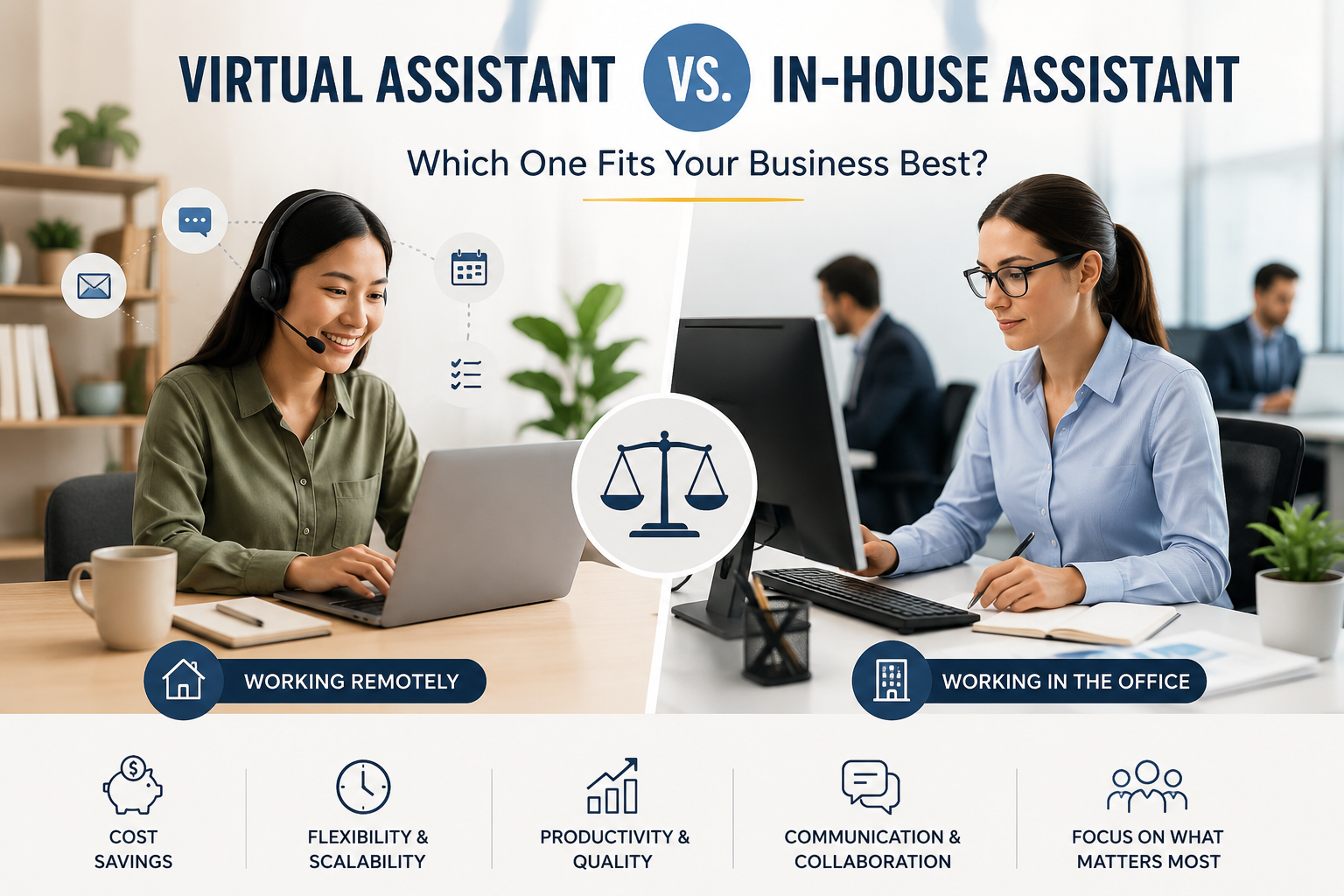
Virtual Assistant vs In-House Assistant: Which One Fits Your Business Best?
If you feel like your day is constantly filled with emails, scheduling, follow-ups, and other admin work, you’re definitely not alone. Many business owners reach a point where they realize they’re spending more time managing tasks than actually growing their business.
At some point, the question becomes simple: Do I need help?
For many, the answer is yes. In fact, hiring an assistant—whether virtual or in-house—can save hours every week. That extra time can be redirected toward strategy, client relationships, and business growth. But the real challenge is not whether you need help. It’s deciding what type of assistant is right for you. Should you hire someone who works in your office every day? Or would a remote, flexible virtual assistant be a better fit?
In this article, we’ll walk through both options in a simple, practical way so you can decide what works best for your business. We’ll also look at the key differences in cost, productivity, hiring process, flexibility, and communication.
Understanding the Two Options
Before comparing, it helps to clearly understand what each role means.
An in-house assistant is someone who works physically in your office. They are usually full-time employees and become part of your daily on-site team. You can talk to them directly, assign tasks instantly, and supervise their work in person.
A virtual assistant, on the other hand, works remotely. They are not tied to a physical office and usually work as independent contractors or through a service provider like Virtual Staff Labs. They support your business from anywhere, using digital tools for communication, task management, and collaboration.
Both options can be effective. The best choice depends on your business needs, working style, and budget.
Key Criteria for Comparison
To make the decision easier, let’s compare virtual and in-house assistants based on five important areas:
- Cost-effectiveness
- Hiring and onboarding process
- Productivity and work quality
- Flexibility and scalability
- Communication and collaboration
Each of these factors plays a big role in how well an assistant will fit into your business.
1. Cost-Effectiveness
One of the biggest differences between virtual and in-house assistants is cost. Hiring an in-house assistant usually comes with more expenses than just salary. You also need to consider:
- Office space
- Equipment (laptop, desk, supplies)
- Benefits and insurance
- Taxes and other employer costs
These additional expenses can significantly increase the total cost of employment. In many cases, employer overhead can add a large percentage on top of the base salary. This means the real cost of hiring someone full-time in your office is much higher than it appears at first glance.
Virtual assistants, however, usually work on a contract or hourly basis. This means you only pay for the actual time they work. There are no office space costs, no equipment setup, and no long-term employee overhead. This setup makes virtual assistants a more cost-efficient option for many businesses, especially small to medium-sized companies that want professional support without heavy fixed expenses.
With Virtual Staff Labs, businesses can access skilled virtual assistants without the financial burden of maintaining a full-time in-office employee.
2. Hiring and Onboarding Process
Hiring an in-house assistant can take time. You usually need to:
- Post job listings
- Review applications
- Conduct multiple interviews
- Run background checks
- Train the new employee
- Wait through notice periods
Depending on the role and location, the process can take several weeks or even months. Another limitation is the talent pool. You are usually restricted to candidates within your local area, which can limit your access to specialized skills.
Virtual assistant hiring works differently. Through Virtual Staff Labs, the hiring process is designed to be faster and more streamlined. Instead of you spending time searching and screening candidates, the matching process is handled for you.

Once your needs are clearly defined, you are typically matched with a suitable virtual assistant within a short period of time. These assistants are pre-screened through:
- Skills assessments
- Interviews
- Background and reference checks
- Confidentiality agreements
This means you get access to qualified professionals without going through a long and tiring recruitment process.
For business owners who need support quickly, this can be a major advantage.
3. Productivity and Work Quality
A common concern with remote work is whether virtual assistants can perform as well as in-office staff. However, many studies and workplace observations suggest that remote workers can be highly productive—sometimes even more productive than traditional office employees.
One reason is fewer distractions. Remote assistants often work in environments designed for focus, which allows them to complete tasks efficiently. They also tend to have better work-life balance, which can reduce burnout and improve consistency in performance over time.
In-house assistants, however, offer a different advantage. Because they are physically present in your office, they can:
- Respond immediately to urgent tasks
- Receive real-time instructions
- Participate in face-to-face discussions
- Be supervised more directly
This can be useful for roles that require constant interaction or quick on-site decision-making.
Both options can deliver high-quality work. The key difference is how the work is managed and communicated.
4. Flexibility and Scalability
Flexibility is one of the strongest advantages of virtual assistants.
With virtual support, you can easily adjust working hours based on your business needs. If your workload increases, you can add more hours. If things slow down, you can scale back without the stress of restructuring a full-time position. This makes virtual assistants especially helpful for:
- Seasonal businesses
- Startups with changing workloads
- Companies testing new projects
- Businesses trying to control costs
With Virtual Staff Labs, flexible monthly arrangements allow businesses to start small and grow support as needed.
In-house assistants, on the other hand, are usually full-time employees. While this can be beneficial for companies that require constant in-office support, it also means you are paying a fixed cost regardless of workload changes. During slow periods, this can lead to paying for time that is not fully utilized.
5. Communication and Collaboration
Communication is often the deciding factor for many business owners.
In-house assistants offer the advantage of immediate, face-to-face communication. You can quickly clarify tasks, provide feedback, and observe work progress in real time. They can also integrate more naturally into your office culture and team environment.
Virtual assistants rely on digital communication tools such as email, messaging apps, and project management platforms. At first, this may feel less direct, but with proper systems in place, communication can be just as effective. In fact, many virtual teams develop very structured communication habits, including:
- Daily or weekly check-ins
- Task tracking systems
- Standard operating procedures (SOPs)
- Clear documentation of workflows
With the right setup, virtual assistants can work smoothly and independently while still staying aligned with your goals.
Virtual Staff Labs also supports clients in building these systems, helping businesses create clear workflows and communication processes that make remote collaboration efficient and stress-free.
Factors to Help You Decide
.png)
Choosing between a virtual assistant and an in-house assistant is not just about cost or convenience. It’s about what fits your business best. Here are some important questions to consider:
1. What type of tasks do you need help with?
If your tasks are mostly digital—like email management, scheduling, data entry, customer support, or research—a virtual assistant can handle them effectively.
If your tasks require physical presence—like handling office visitors or managing on-site operations—an in-house assistant may be better.
2. What is your budget?
Virtual assistants are generally more cost-flexible. If you want to reduce fixed overhead costs, this option may be more practical.
3. How fast do you need support?
If you need help quickly, virtual assistants can usually be onboarded faster compared to in-house hiring.
4. What is your work style?
If you prefer face-to-face interaction and direct supervision, in-house support might feel more comfortable. If you are open to remote collaboration and digital tools, virtual assistants can work very effectively.
5. What are your long-term goals?
If you are planning to scale your business, virtual assistants offer more flexibility to grow support without increasing fixed costs too quickly.
There is no single “perfect” answer when choosing between a virtual assistant and an in-house assistant. Both have strengths, and both can be valuable depending on your situation.
In-house assistants are great for businesses that need physical presence, direct supervision, and constant in-person collaboration.
Virtual assistants, on the other hand, offer flexibility, cost efficiency, and access to a wider talent pool. They are especially useful for modern businesses that rely heavily on digital tools and remote workflows.
For many business owners today, virtual support is becoming the more practical and scalable choice.
Ready to Find the Right Support for Your Business?
If you’re still unsure which option is right for you, the best next step is to look at your current workload and identify which tasks can be delegated. A clear breakdown often makes the decision much easier.
At Virtual Staff Labs, we help business owners understand their support needs and connect them with trained virtual assistants who can step in and make an immediate impact. Whether you need part-time help or ongoing support, we can help you build a setup that works for your business goals.
If you’re ready to reclaim your time and focus more on growing your business, reach out to Virtual Staff Labs today to explore your virtual assistant options and find the right match for your needs.